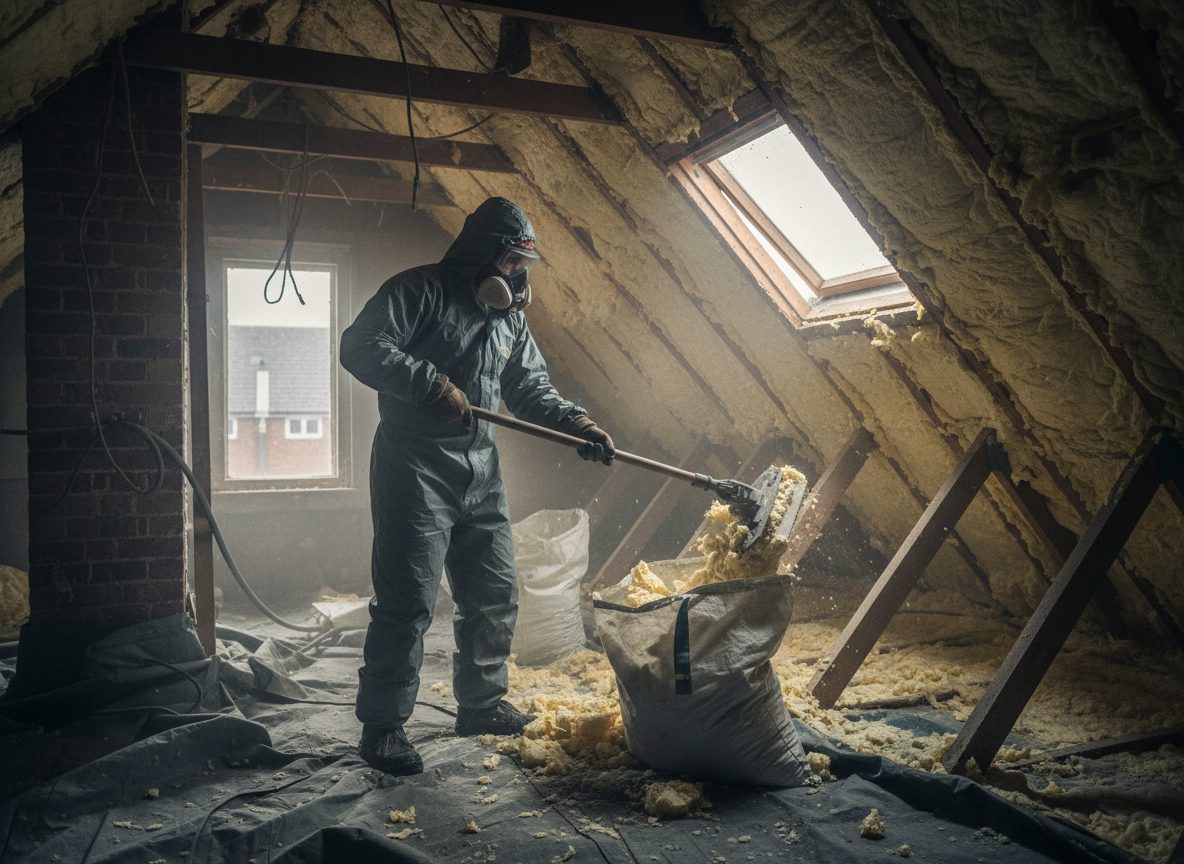
Hull's older terraced houses, especially those built before the 1950s in areas like Newland and Sculcoates, often received closed-cell spray foam in the 2000s to cut heating costs. Over time the foam traps condensation against rafters and can block the limited eaves ventilation typical in these narrow pitched roofs. Removal requires careful sectioning so the foam does not tear off timber fibres or dislodge original lath and plaster ceilings below.
Work in the HU4 and HU5 postcodes frequently encounters fibreglass overlays or mineral wool that was added later, creating mixed layers that must be separated before disposal. The river breeze and frequent damp winters mean any exposed roof deck must be checked for soft spots immediately after foam is stripped; leaving the loft open overnight risks driving rain into the void. NexaClean Crew works from 317 Boothferry Road and can attend 24/7 when a sudden leak is discovered.
Local building control in Hull now requires that any new insulation meets current ventilation standards, so the team documents the original rafter spacing and any existing vents before starting. Homeowners on streets near the Humber often find the foam has wicked moisture from the estuary air into party walls, creating hidden staining that only appears once the material is gone.
Technician insight
In Hull, the thing that catches most people out with loft spray foam removal is how the constant moisture from the Humber gets trapped behind the foam in pre-1930s terraces; once the foam is stripped you often find the original felt has started to rot along the eaves on streets running toward the docks.
Foam Removal in a Newland Avenue Terrace
Homeowner noticed musty smells after heavy winter rain. Inspection found closed-cell foam covering blocked eaves vents in a 1920s two-up two-down. The team cut the foam into strips, removed it without disturbing the ceiling, then confirmed the rafters were still sound. New soffit vents were recommended before any re-insulation.
How it works
- 1
Loft Inspection
Assess foam type, depth, roof condition and any existing insulation layers through a non-destructive survey.
- 2
Site Protection
Seal the loft hatch and lay floor protection before cutting the foam into manageable sections.
- 3
Foam Extraction
Remove material in controlled strips, bagging waste on site to limit dust spread through the house.
- 4
Post-Removal Check
Inspect rafters and ceiling for moisture damage, photograph findings and advise on any follow-up repairs.
Pricing
Cost varies with loft size, foam thickness and access; an upfront quote is provided after inspection.